Severance Pay in Korea for Foreign Workers: Eligibility, Calculation, and Unpaid Claims

Foreign workers in Korea may qualify for severance pay after meeting legal employment conditions, but contracts, working patterns, and evidence determine the claim.
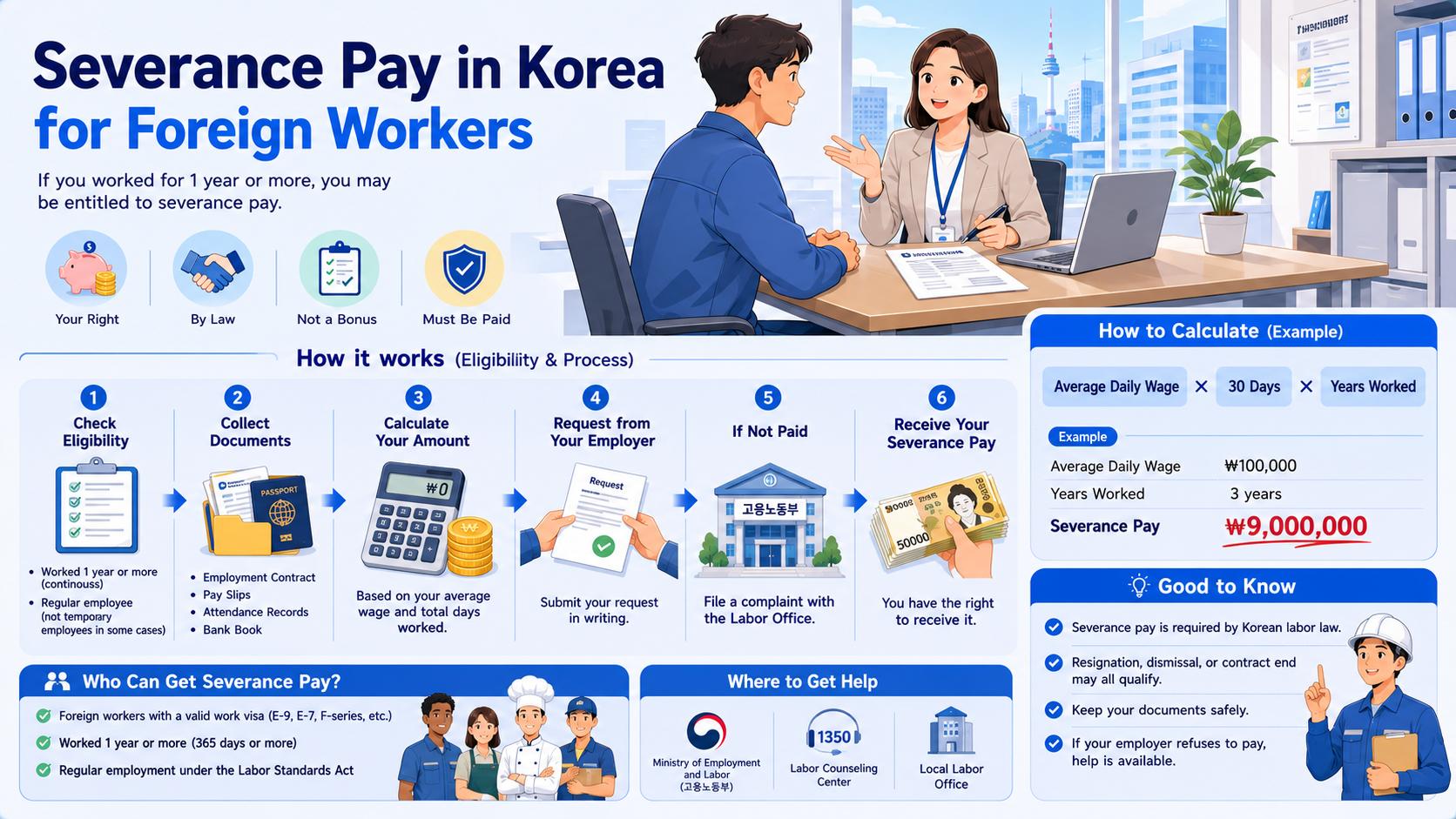
What Is Severance Pay in Korea?
Severance pay is compensation that an eligible worker may receive when employment ends. It is separate from the final monthly salary, unused wage payments, and other amounts the employer may owe.
Foreign nationality alone does not remove labor rights. The important questions are whether the worker meets the legal employment conditions and whether the work relationship can be proven.
Important: Eligibility can depend on employment duration, average weekly working time, worker classification, and the actual facts of the job.
Who May Be Eligible?
A common starting point is whether the employee worked continuously for at least one year. However, the complete assessment can also involve working hours and whether the person legally qualifies as an employee.
- You worked under the employer’s direction and schedule.
- You received wages in exchange for your labor.
- Your continuous employment period meets the legal requirement.
- Your working pattern meets the applicable minimum conditions.
- You can prove when the employment began and ended.
Situations That Need Extra Review
| Situation | Why It Is Complicated | Evidence to Prepare |
|---|---|---|
| Part-time work | Weekly hours and continuous service must be checked | Schedules, time records, and wage statements |
| No written contract | The employer may deny employment conditions | Bank transfers, messages, photos, and work records |
| Multiple short contracts | The employer may claim there was no continuous service | Renewal records and proof that work continued |
| Freelancer contract | The contract name may differ from the real working relationship | Instructions, fixed schedules, supervision, and payment records |
| Employer closed the business | Documents and contact information may disappear | Business information, messages, contracts, and wage records |
How Severance Pay Is Generally Determined
Korean severance pay is generally connected to the worker’s average wage and eligible period of service. The exact calculation may be affected by regular wages, bonuses, allowances, unpaid absences, and the employment-ending date.
Do not rely only on a rough online calculator when there are irregular payments, unpaid wages, or disputed working periods.
Documents You Should Collect
- Employment contract and contract renewals
- Bank statements showing salary payments
- Payslips and annual income statements
- Work schedules and attendance records
- Messages with the employer or manager
- Resignation letter or termination notice
- Records showing the final working date
- Documents showing unpaid salary or overtime
Step-by-Step: What to Do Before Leaving the Job
Step 1: Confirm Your Official Employment Dates
Check the date written in your contract, the date you actually started working, and the date employment ends. If these dates are different, keep evidence of the real working period.
Step 2: Request a Written Payment Statement
Ask the employer to provide a breakdown of final salary, severance pay, unused payments, deductions, and the expected payment date.
Step 3: Save Evidence Before Access Is Removed
Download schedules, workplace messages, digital payslips, and attendance records before your company account is closed.
Step 4: Do Not Sign an Unclear Settlement
Some documents may say that all wages and claims have been fully settled. Do not sign before checking the amount and meaning.
What to Do If Severance Pay Is Not Paid
- Calculate the amount you believe is unpaid.
- Ask the employer for payment in writing.
- Set out the employment period and unpaid amount clearly.
- Contact the Ministry of Employment and Labor if payment is refused or delayed.
- Submit supporting records with the complaint or petition.
- Keep all submission receipts and case information.
How to Present the Claim
“I worked for the company from [start date] to [end date]. My regular work schedule was [schedule]. My final salary and severance pay have not been fully paid. The unpaid amount is approximately [amount]. I have attached my contract, bank records, schedules, and messages.”
Does Reporting the Employer Affect Your Visa?
A labor claim and an immigration report are different procedures. However, if your employment ends, your visa may require a separate workplace-change or status report.
Do not assume that filing a labor complaint automatically updates immigration. Check both issues independently.
Common Employer Arguments
- “You were a freelancer.” The actual working relationship may matter more than the contract title.
- “You resigned, so there is no severance.” Voluntary resignation does not automatically remove eligibility.
- “Your visa was different.” Immigration violations and unpaid labor claims are separate legal questions.
- “The business has no money.” Financial difficulty does not by itself prove that no wages are owed.
Common Mistakes Foreign Workers Make
- Waiting months because the employer promises to pay later
- Deleting messages after leaving the company
- Accepting cash without keeping payment records
- Signing a settlement they cannot read
- Leaving Korea without checking how to continue the claim
- Confusing final salary with severance pay
Frequently Asked Questions
- Can a foreign worker receive severance pay?
Foreign workers may qualify when they meet the applicable labor-law conditions. Nationality alone is not the deciding factor.
- Can I claim without a written contract?
A missing contract makes the case harder but does not necessarily end it. Other records can help prove employment.
- Does quitting voluntarily remove severance rights?
Eligibility is not automatically lost because the employee resigned. The employment conditions and service period must be reviewed.
- Where can I ask questions?
The Ministry of Employment and Labor provides consultation through its labor counseling channels, including 1350 within Korea.
Related Articles
- Unpaid Wages in Korea for Foreign Workers
- Korean Employment Contract Guide
- Changing Employers on a Korean Work Visa
- Labor Office Complaint Guide
Official Ministry of Employment and Labor: https://www.moel.go.kr/english
Please log in.