Can foreign residents in Korea earn a UK university degree online?
“Can I earn a UK university degree while living or working in Korea?”
“Can anyone apply for a Top-up course that takes one year?”
If you live in Korea, you may also be wondering whether your previous education from another country will be accepted, what English evidence you need, and how to submit your documents. The short answer is that online study routes are available, but living in Korea or holding a particular nationality does not guarantee admission. Your previous education, subject background, English proficiency, and the university’s admissions decision all matter.
Hello, we’re Passmakers, helping learners find education routes that fit their academic background and goals. In this article, we explain what foreign residents in Korea should consider before pursuing a UK degree through ICL.
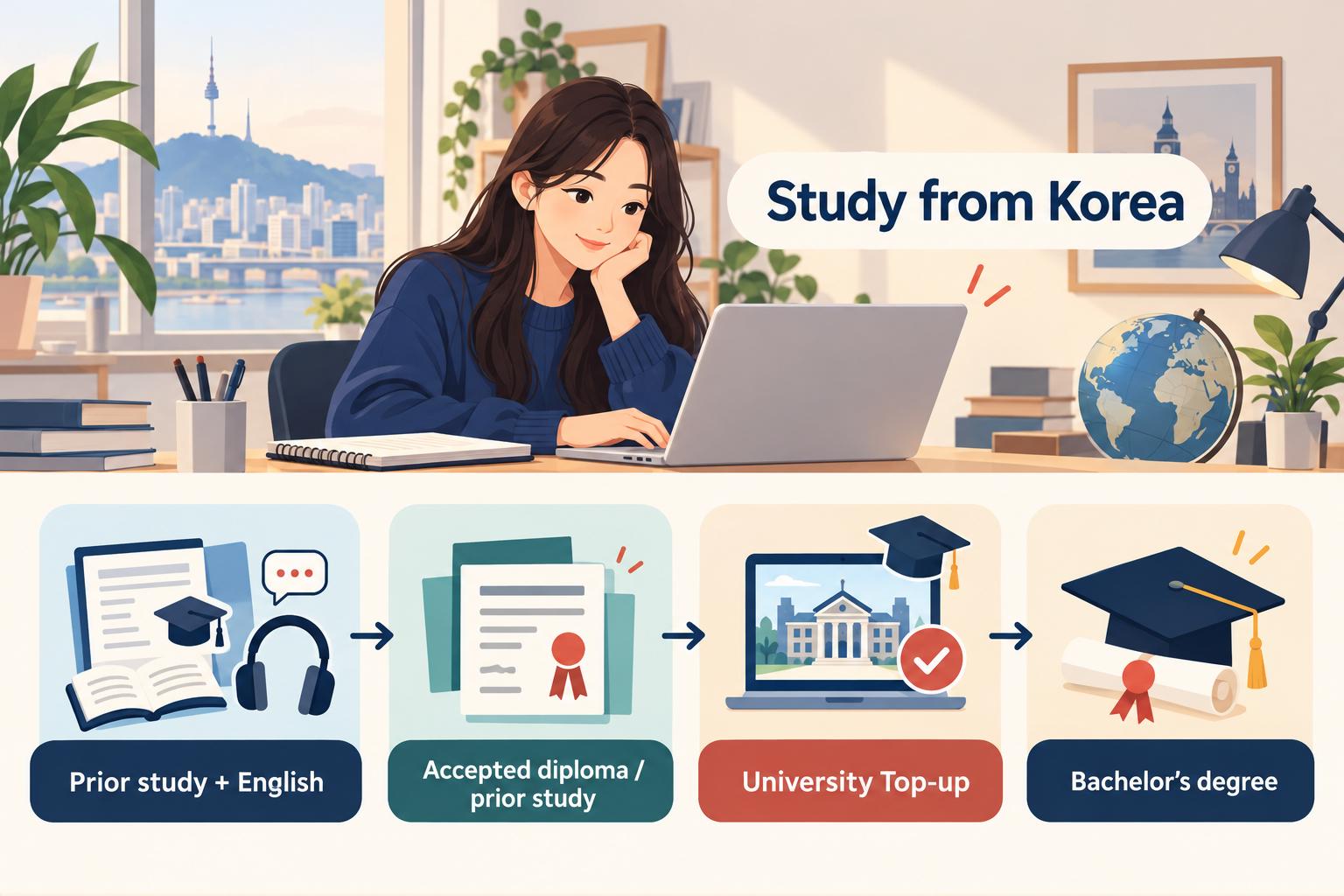
What is the difference between an online bachelor’s degree and a Top-up?
“Online bachelor’s degree” describes a way of studying remotely. A Top-up is a route for learners who have already completed a relevant diploma or prior university-level study and need to complete the remaining part of a bachelor’s degree. It often covers the final-year level of study, but the duration and delivery method vary by university and course.
So, do not assume that a course described as “one year” means the entire degree takes one year. That may be the time needed to complete the degree after you already meet the required entry conditions. If you are starting after high school, you may need to complete a diploma or another preparatory stage first.
An ICL diploma is a separate step from a bachelor’s degree
The OTHM Level 4 and Level 5 business diploma described by ICL consists of 12 mandatory units and 240 UK credits. It covers business topics at a level comparable to the first and second years of a UK undergraduate course and may provide a route to apply for a related university Top-up.
Completing the diploma does not automatically award you a UK bachelor’s degree. The university you apply to must assess your qualification and subject content. You then need to receive an offer and meet that university’s study and graduation requirements to earn the degree. UK credits and Korean academic credits use different systems, so they should not be converted by comparing the numbers alone. Instead, look at whether your target university accepts the specific qualification.
Your education from your home country may be considered
If you have completed high school, review the diploma’s academic and age requirements and when you can start. If you have graduated from, attended, or withdrawn from a college or university, the school may assess your previous study based on your institution, major, completed subjects, and grades. Having attended university does not automatically qualify you for a Top-up.
Depending on the university, international academic records may need to include English-language versions of your graduation and transcript documents, translations, notarisation, or an apostille. Requirements and submission methods vary by country and university, so prepare your documents according to the instructions for your application.
Review English requirements and how classes are delivered
The English requirements for a diploma and those for your final university course may differ. Find out whether English evidence or an alternative assessment accepted by ICL will also be accepted by your target university, and whether an approved English test such as IELTS is required. Along with test preparation, you may want to build the academic English skills needed to read subject materials and write essays and reports.
Even when a course is online, live classes, exams, assignment submissions, and tutor feedback can vary. Review whether class times work with the Korean time zone, which language is used for teaching and coursework, and what study workload the estimated completion time assumes. Some courses may also require in-person attendance or travel to a campus outside Korea.
Consider the degree-awarding university and your Korean stay conditions
Before applying or enrolling, distinguish between the university that awards the degree, the institution that delivers the teaching, and the location and format of the course. If you plan to use the degree for employment or postgraduate study in Korea, review the academic credentials and documents required by the employer or school.
Enrolling in an online course does not change your Korean immigration status or work permission. Whether your current status allows study or other activities depends on your individual circumstances. For immigration-related guidance, follow the information provided by the Korea Immigration Service or Hi Korea.
If you are preparing for a UK online degree while living in Korea, start by gathering your highest qualification, the country where you earned it, your preferred subject, your English preparation status, and the time you can set aside for study. Then compare these details with the entry qualifications and study format accepted by your target university.
Passmakers can explain what to review before you pursue an ICL diploma or apply for a UK university Top-up, based on your academic background and study goals.
Would you like to know which stage you could start from? Please contact Passmakers with your highest qualification, the country where you earned it, your preferred subject, and your current English preparation status.
https://naver.me/xE6k4M14
Por favor conectese primero